

Most loyalty conversations start with the technology and back into the program. It should run the other way. Stamps, points, and tiers are not flavors of the same thing; they are different promises, they reward different behaviors, and the right one depends on what a visit to your business actually looks like.
The wallet pass renders all three beautifully, which is precisely why the choice deserves to be made deliberately. Here is what each mechanic is for.
Stamp cards: reward the visit
The stamp card is the oldest mechanic in retail because it matches the simplest behavior: come back. Buy nine coffees, the tenth is free. Visit five times, get a reward. The unit is the visit, the goal is visible, and the arithmetic requires no explanation.
Stamps shine where transactions are frequent, similarly sized, and quick: coffee, lunch, bakeries, car washes, barbers. The psychology is progress, and progress is the whole design. A customer two stamps from a free coffee behaves measurably differently from one holding a vague points balance, because the finish line is in sight.
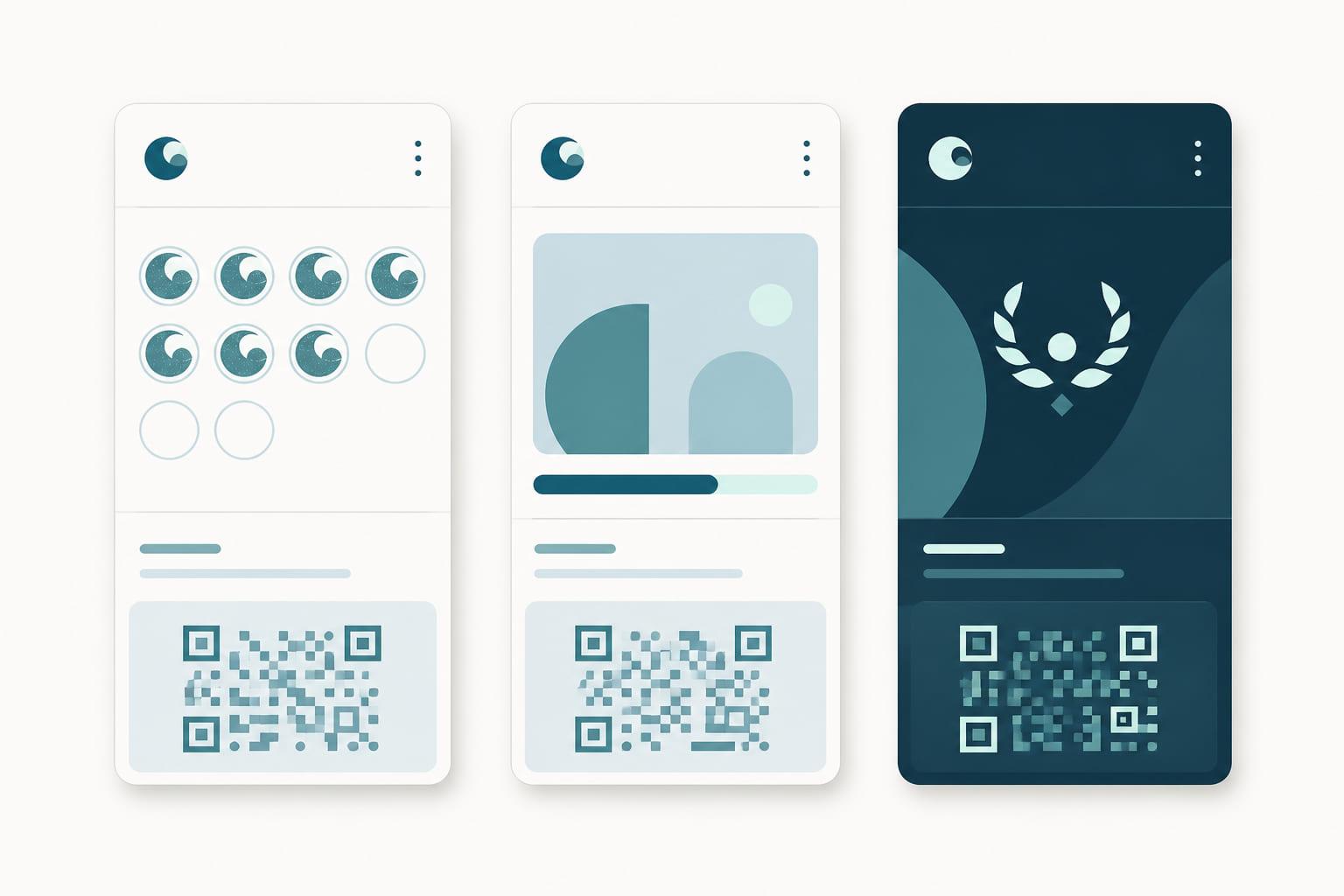
On a stamp card pass, the stamp grid is the primary field: filled and empty markers the customer watches complete, updated the moment a stamp lands, with the lock screen announcing the one that matters most, the reward unlocked. What digital adds to the paper original is everything paper lost: the card cannot be forgotten, the stamps cannot be lost in a jacket pocket, and you finally see the behavior you were rewarding.
Choose stamps when the honest description of loyalty in your business is "comes back often." Avoid them when basket sizes vary wildly, because stamping a 4 coffee and a 90 dinner equally tells your best customers they are ordinary.
Points: reward the spend
Points make value proportional. Spend more, earn more, redeem for rewards. The unit is the krone or euro, not the visit, which is why points suit businesses where baskets vary: fashion, grocery, beauty, home goods, anywhere a customer might spend 15 one week and 300 the next.
Points are also the mechanic of flexibility. A points balance can fund a catalog of rewards, seasonal multipliers, and partner offers, which makes it the natural companion to a CRM running segmented campaigns. That flexibility is the strength and the trap: every layer of earning rules and exclusions moves the program further from a sentence a customer can repeat. The programs that work keep the exchange rate explainable at the till.
On a loyalty pass, the points balance takes the primary field, large and current, with the next reward threshold as a secondary field so the balance always has a meaning. A number that updates within moments of the purchase, and can say so on the lock screen, is a different product from the same number discovered on a statement.
Choose points when spend varies and you want value to track it. Avoid them when your transaction is essentially uniform, where they are just stamps with worse arithmetic.
Tiers: reward the relationship
Tiers reward accumulation with status: bronze, silver, gold, or member and VIP. The unit is the relationship itself, measured over a season or a year, and the reward is standing, better benefits, early access, a different experience at the door.
Tiers suit businesses where identity outweighs transaction: gyms and clubs, hotels, airlines, premium retail, memberships of every kind. Their power is loss aversion; a customer near a tier boundary protects their status, which stamps and points cannot replicate. Their cost is patience: tiers move slowly, so they rarely stand alone, and most tiered programs run points underneath as the engine that moves people between levels.
On a pass, tier is the face. The design itself can change with status, a gold pass looking unmistakably different from the standard one, which turns the wallet into the badge. The tier upgrade is the single most announcement-worthy moment a program has, and the pass delivers it to the lock screen the instant it happens.
Choose tiers when your best customers are meaningfully different from your average ones and would value being treated that way. Avoid them as a first mechanic in a business built on quick, casual visits.
Choosing, and combining
A shortcut that gets most businesses to the right answer: frequent and uniform, stamps. Variable spend, points. Long relationships worth naming, tiers on top of points. Combinations are legitimate, layers on one program, but each layer must earn its complexity; a program you cannot explain in one sentence at a till is already failing at the till.
Whichever mechanic you choose, the wallet pass is where it becomes tangible: the grid that fills, the balance that grows, the color that changes. Stell renders each of these as a live pass in Apple Wallet and Google Wallet, driven by your program's data, and lets the mechanic evolve without reissuing a thing. If you are still weighing which promise fits your business, that is a good conversation to have over a demo, with your own numbers on the table.